From Backlog to Breakthrough: The Case for EAM Productivity Reform
Asset-intensive organizations often leave significant value unrealized because maintenance productivity is constrained by underlying process inefficiencies. Work is delayed by missing materials, unclear priorities, incomplete notifications, and late permit coordination. Schedules weaken, overtime rises, and planners shift from optimization to reactive decision-making. Over time, these issues drive higher unplanned work, growing backlogs, reduced reliability, and avoidable downtime and external spend. This is not a workforce issue, but a structural process challenge that compounds when left unaddressed.
Improving EAM productivity is one of the most effective opportunities to enhance operational performance. By removing workflow barriers, reinforcing readiness discipline, and improving execution flow, organizations unlock capacity without added headcount or capital. The results are measurable: shorter cycle times, higher wrench time, more stable schedules, and improved reliability. Financial benefits follow quickly—supporting higher asset availability, lower maintenance cost, and safer, more predictable operations aligned with S/4-era expectations.
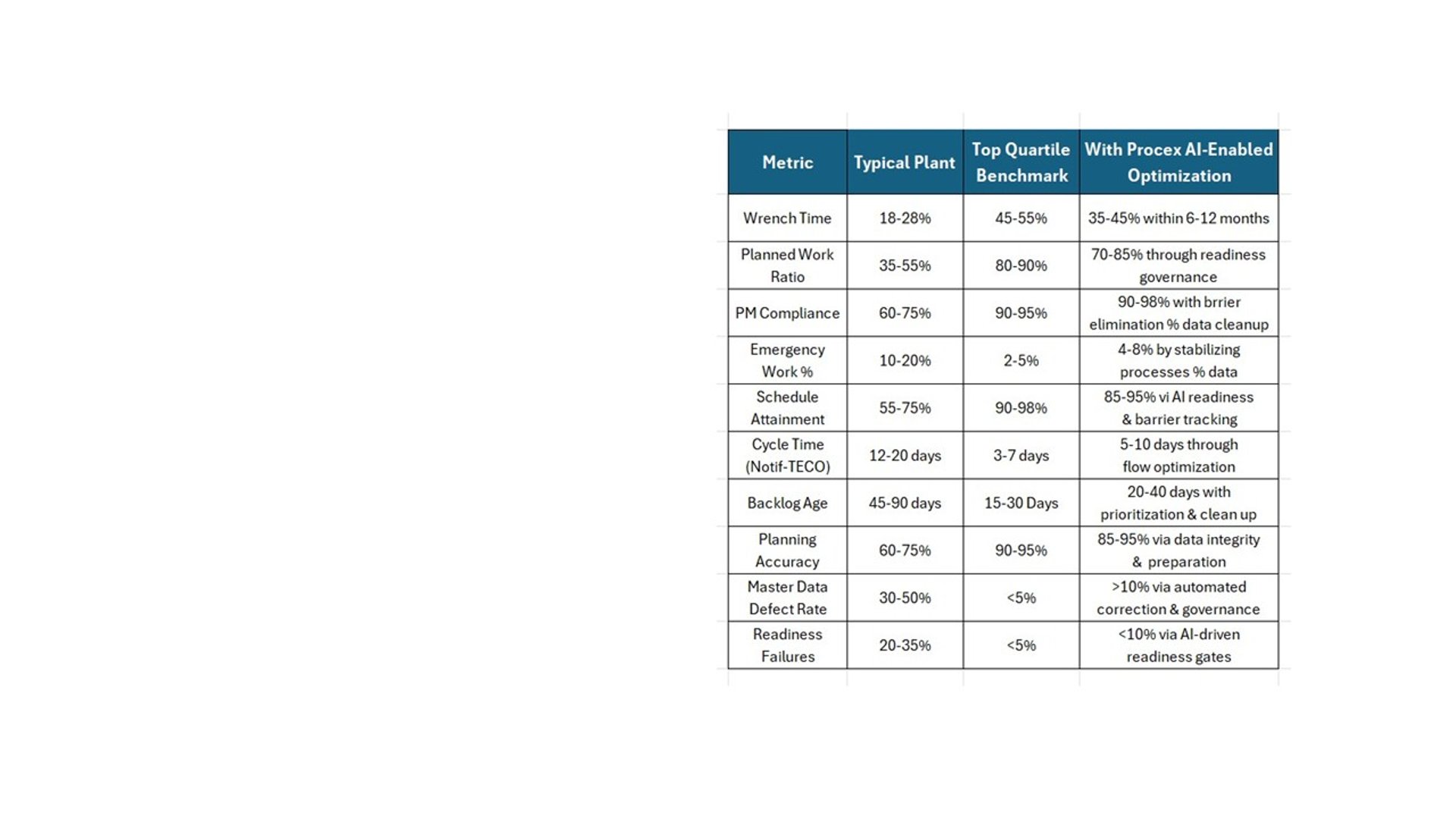
EAM Performance Benchmark Comparison Typical - Top Quartile - With Procex
Procex Technology, Inc.
1326 N. Sandburg Ter.
Chicago, IL 60610
gET IN TOUCH
+1 (312) 480-8888
© 2026. All rights reserved Procex Technology, Inc.
Privacy Policy and Terms of Service